 Client trainingVisited 0 of 32 modules
How a medspa is valued
After this module you know that a clinic is priced as a multiple of adjusted EBITDA, what the multiple ranges are for a business like yours, the five things that move the multiple, and why the books you keep in year one set the price in year five.
Five minutes: the formula, the 2026 ranges, and the five things that move the multiple.
The formula
Most medspa sales come down to one line: adjusted EBITDA times a multiple. (Very small clinics are sometimes priced on seller's discretionary earnings instead, which adds the owner's full pay back; the idea is the same.) The EBITDA comes from Finance 5. The multiple is what buyers in the market are paying for a dollar of that earnings right now, and it depends on how much they trust the dollar to keep showing up after you leave.
A plain web search returns the same ranges the advisors below publish, which is a useful sanity check when someone quotes you a number.
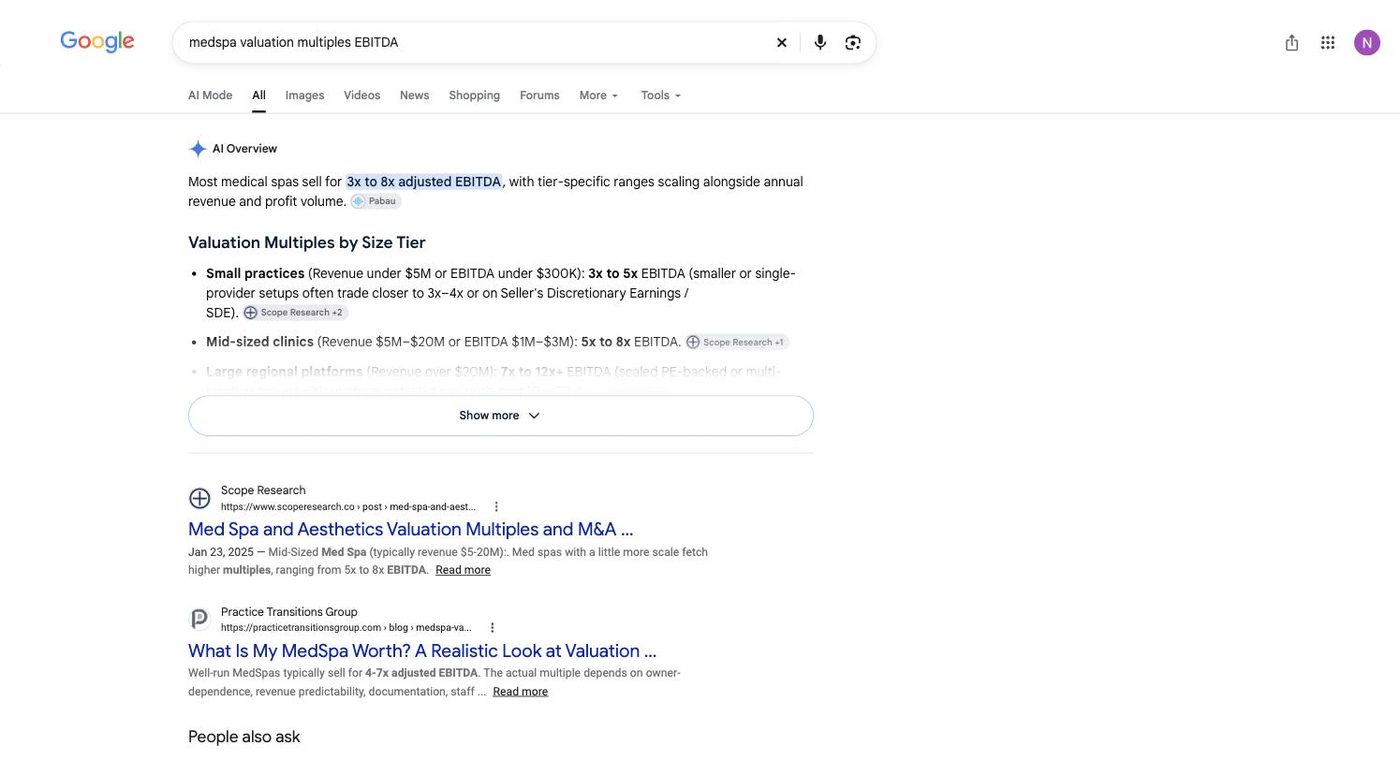
What the market says in 2026
Three sell side advisors (firms that represent owners in a sale) published ranges this year. They agree more than they disagree.
| Source | Range | Applies to |
|---|---|---|
| FOCUS Investment Banking, Aug 2026 | 3x to 6x adjusted EBITDA | Smaller medspas |
| FOCUS | 5x to 8x | Mid sized operators |
| FOCUS | 7x to 12x | Established regional platforms |
| Breakwater M&A, 2026 | 3.5x to 5.0x | Owner dependent, limited documentation |
| Breakwater | 5.0x to 6.5x | Single location with SOPs and solid retention |
| Breakwater | 7.0x to 9.0x | Multi provider, recurring revenue, 15%+ growth |
| CT Acquisitions, Jul 2026 | 5.0x to 7.0x, median 5.5x to 6.5x | $1M to $3M adjusted EBITDA |

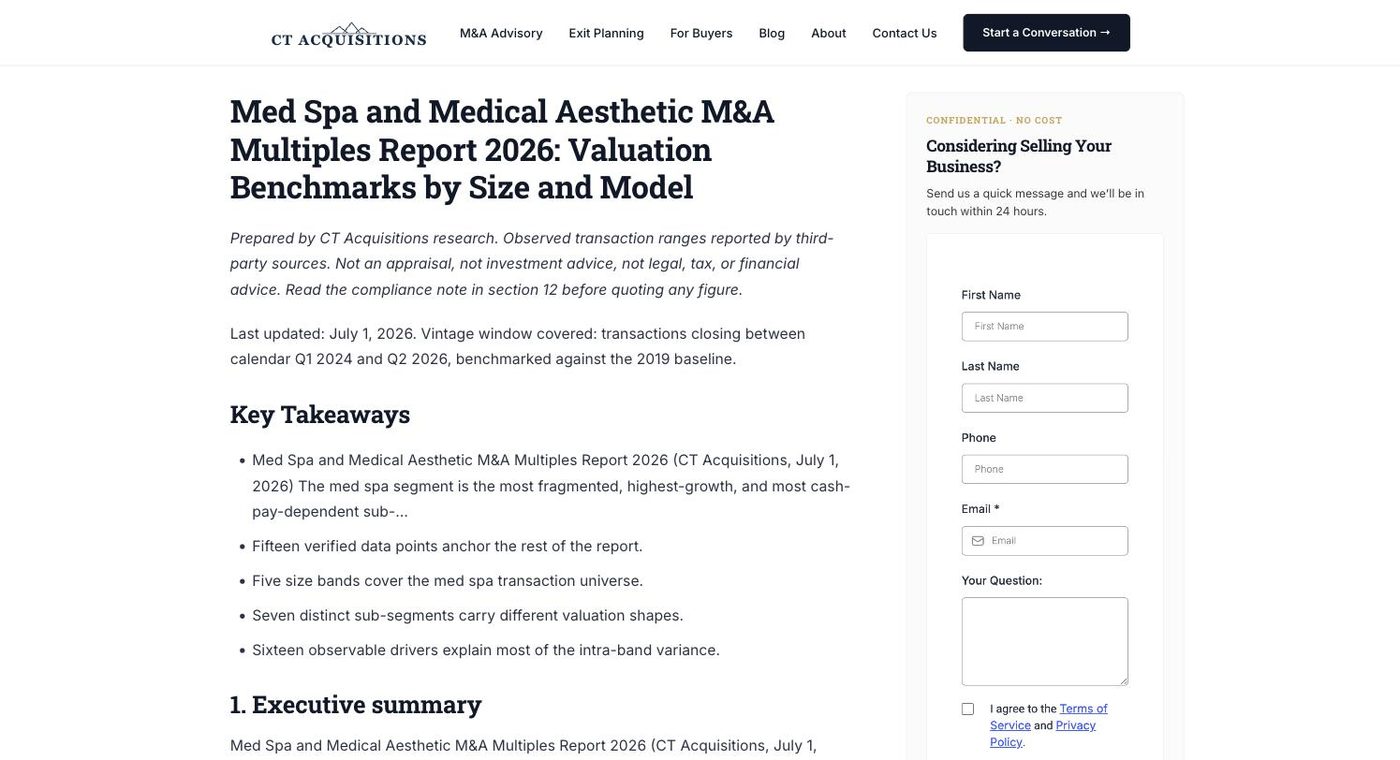
A note on the sources: all three are sell side advisors, who benefit when owners believe multiples are high. Treat the top of each range as achievable, not typical.
Try the range on Harbor Aesthetics
Harbor's adjusted EBITDA from Advanced 4 was $228,000. At that size it sits at the small end of the market, where 3x to 5x is realistic and 6x is a strong outcome. Move the slider and watch what one turn (one whole number) of the multiple is worth.
The five things that move the multiple
- Recurring revenue
- Memberships and subscriptions make next year's revenue predictable. CT Acquisitions reports that membership at 30 to 40 percent of revenue adds roughly half a turn to a full turn of multiple, the largest single lever in their data.
- Provider independence
- If the owner performs most of the treatments, the earnings leave with the owner. CT Acquisitions reports a discount of half a turn to a full turn when a single provider is above about 35 percent of revenue. Multiple injectors, written protocols (SOPs) and a medical director who is not the sole producer all push the other way.
- Physician integration
- A physician owned practice with a compliant management company removes a category of legal risk that private equity buyers price heavily.
- Service mix and retention
- Injectables weighted clinics trade higher than device weighted clinics because the patient comes back every three to four months. CT Acquisitions cites a return visit rate above 65 percent over twelve months as the benchmark.
- Clean, accrual books
- Most buyers of a clinic this size commission a quality of earnings review: an accountant rebuilds your EBITDA from bank statements and source documents. Deferred revenue handled correctly, inventory counted, intercompany accounts tied, add backs documented, reconciliations complete. A clinic that passes cleanly closes at the agreed price; one that does not usually gets repriced.
How a deal is actually paid
The headline number is rarely all cash. The advisors above describe typical structures of 60 to 80 percent cash at close with 10 to 25 percent in an earnout (paid later if the clinic hits agreed targets) and sometimes a rollover (you keep a stake in the buyer's company). The books matter here too: an earnout is measured on the same EBITDA definition, so the accounting you agree to at signing is the accounting that pays you two years later.
Why this matters in year one
Nobody sells in year one. But every driver above is built or broken in year one: the membership program, the second injector, the deferred revenue account, the inventory count, the habit of never running a personal expense through the clinic. A buyer will read three years of financials. The first of those three years starts when you open. That is the reason the books are set up the way they are from the first month.
Try it yourself
A clinic has adjusted EBITDA of 400,000 and a buyer offers 5x. The headline price is
400,0002,000,0005,000,000Which change most reliably raises a clinic's multiple?
A new logoGrowing membership revenue to a third of the totalBuying a second laserThe owner performs 70 percent of treatments. A buyer will
Pay more, because the owner is clearly skilledPay less, because the earnings depend on one person who may leaveNot careA quality of earnings review is
A patient satisfaction surveyThe buyer's accountant rebuilding your EBITDA from source documentsAn IRS auditWhy do year one books matter for a sale in year five?
They do notBuyers read three years of financials, and the habits that drive the multiple start on day oneBecause the multiple is set by the first year's revenue