 Client trainingVisited 0 of 32 modules
Cost savings 101: the seven leaks
Most clinics that feel tight are not short of revenue. They are leaking it in seven places, and the same seven every time. This is what the 10-Day Sprint looks for, in the order we look, with what you can check yourself this week.
The order matters
Payroll first, because it is the biggest line. Product cost and pricing next, because together they are the margin on every visit. Then the contracts, fees and subscriptions that quietly renew. Compliance last, because a gap there is not a leak, it is a hole.
Leak 1. Payroll
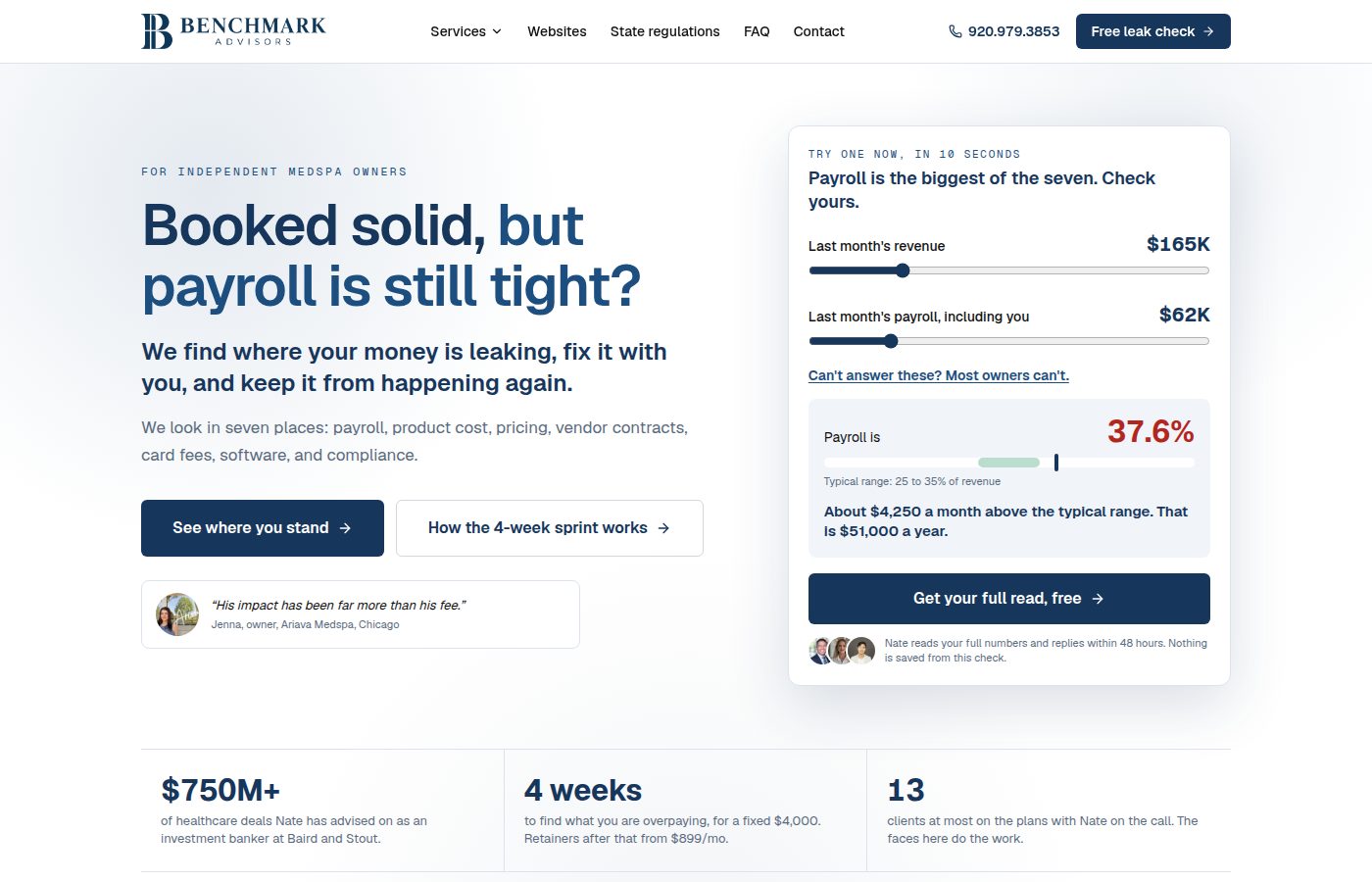
Add up every payroll line: providers, front desk, your own salary, taxes, benefits. Divide by revenue. Most well run clinics land between 25 and 35 percent. Above 40 percent and there is a structural problem: too many hours on the schedule for the bookings, a commission plan that pays on revenue the clinic does not keep, or an owner salary the clinic cannot carry yet. The fix is rarely a layoff. It is usually the schedule template, the commission base, and hours matched to demand by day.
| Check | What to look for |
|---|---|
| Commission base | Pay on service revenue net of product cost, or on collected revenue, never on gross including retail tax and package sales not yet delivered. |
| Hours versus bookings | Provider hours by weekday against appointments by weekday. Tuesday morning staffed like Saturday is a leak. |
| Front desk hours | One desk person per 25 to 30 visits a day is a working rule. |
| Owner pay | Market rate for the role you actually do (Advanced 4). Overpaying hides profit; underpaying hides a problem. |
Leak 2. Product cost
Injectables are the biggest cost after people, typically 25 to 30 percent of revenue across the clinic, and the one where the leaks are invisible until you count. The three places it goes: paying more per unit than you need to, using more per treatment than you charge for, and waste (expired, dropped, reconstituted and not used). Operations 3 is the count; this is the buying.
- Manufacturer loyalty and volume programs. The major neurotoxin and filler makers run tiered pricing and rebate programs. Most clinics are on the wrong tier for their volume, or are not consolidating purchases to reach the next one.
- Buying groups. Group purchasing organizations for aesthetics negotiate pricing small clinics cannot. Worth a call once you pass about $10,000 a month in product.
- Order cadence. Ordering weekly in small lots costs shipping and misses tiers. Ordering quarterly ties up cash and risks expiry. Monthly, against par levels, is usually right.
Leak 3. Pricing
Price per unit, minus product cost per unit, minus the provider's commission on it, is what the clinic earns on a unit of neurotoxin. Many clinics have never done that arithmetic and are earning less per unit than they think, especially after a supplier increase they did not pass on. Two rules: know your cost per unit to the cent, and reprice within a month of any supplier change. Discounting is pricing too: a "first visit special" that is below cost is marketing spend, and should be counted as such.
Leak 4. Vendor contracts
Equipment leases, laser service plans, the booking platform, the phone system, linen, cleaning, waste disposal. Each one renews on its own schedule, usually automatically, usually with an increase. Pull every contract into one list with the renewal date, the notice period and the monthly cost. Then call the three biggest before their notice window closes. A laser service plan alone is often $500 to $1,500 a month and is frequently negotiable, or unnecessary once the warranty runs.
Leak 5. Card processing fees
Divide last month's total processing fees by the volume processed. That is your effective rate. Most clinics run 2.6 to 3.5 percent; a clinic doing $150,000 a month at 3.2 percent pays $4,800 a month, and a move to 2.6 percent is $900 a month back. Ask for interchange-plus pricing rather than a flat rate, remove the fees you are not using (PCI non-compliance fees, statement fees, monthly minimums), and check whether the processor bundled into your booking software is the expensive one. Surcharging patients is legal in most states within card network rules and never on debit cards; it is also a retention risk, so we usually negotiate the rate instead.
Leak 6. Software
List every subscription on the card statements: booking, EMR, marketing automation, email, texting, reviews, scheduling, forms, storage, design tools, the second and third one you tried and never cancelled. A typical single location clinic carries $1,500 to $3,000 a month in software, and a third of it is either duplicated or unused. Cut the duplicates, downgrade the seats, and put every renewal on one calendar.
Leak 7. Compliance
Not a cost you save; a cost you avoid. The compliance check in the sprint covers your medical director agreement, supervision and delegation, who may perform which treatment, good faith exams, licenses, and consent forms, against your state's rules. A gap here is a fine, a board complaint, or a buyer walking away in diligence. We flag gaps for your attorney to confirm; it is not legal advice.
What it adds up to
Two examples from clients, with permission and rounded: one clinic cut more than $3,000 a month in expenses; another kept $4,000 to $7,000 a month after a vendor deal. The pattern is the same every time: nobody was careless, the leaks were just spread across seven places nobody looked at together.
Try it yourself
Payroll at 42% of revenue most often means
Staff are overpaidHours on the schedule do not match bookings, or the commission base is wrongRevenue is fine, ignore itYour effective card processing rate is
The rate on the contractTotal fees divided by volume processedThe interchange rateThe supplier raised neurotoxin by $1 a unit in August. It is now November and prices have not moved. What happened to margin?
NothingIt fell by $1 a unit on every unit since AugustIt rose, because revenue is upA $99 neurotoxin deal on a discount platform is best treated as
RevenueMarketing spend, and measured on whether those patients returnA membershipThe compliance check is
Legal adviceA review of your agreements, supervision and consents against your state's rules, flagged for your attorneyOptional